
NBRACER Scientific Publications
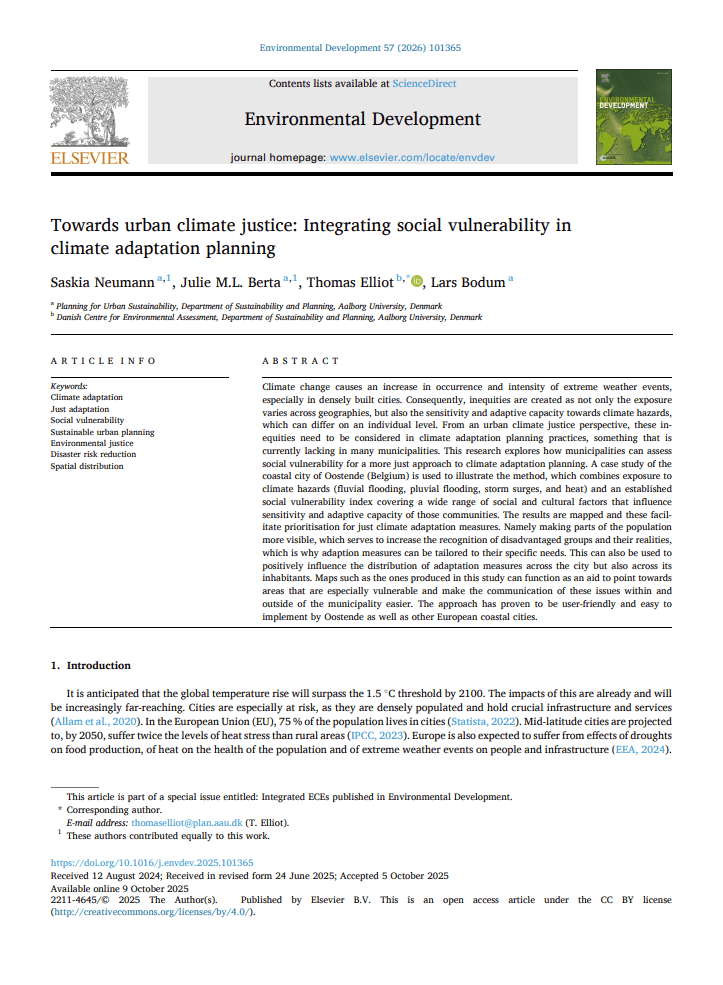
Towards urban climate justice: Integrating social vulnerability in climate adaptation planning
Authors
Saskia Neumann, Julie M.L. Berta, Thomas Elliot, Lars Bodum
Published 9 October 2025, This article is part of a special issue entitled: Integrated ECEs published in Environmental Development, Science Direct.
The paper demonstrates how cities can integrate social vulnerability into climate adaptation planning by combining hazard-exposure data with a Social Vulnerability Index. Using Oostende as a case study, the authors map where high climate risks and vulnerable populations overlap—mainly in the dense city centre with lower incomes, more renters and more elderly residents. This approach is straightforward for municipalities to apply, helps identify priority areas for action and supports more equitable, targeted and socially aware adaptation decisions. It also encourages cross-department collaboration and strengthens justice considerations within local climate strategies.
Substantial increase in wildfire danger conditions under anthropogenic climate change in Southwest France
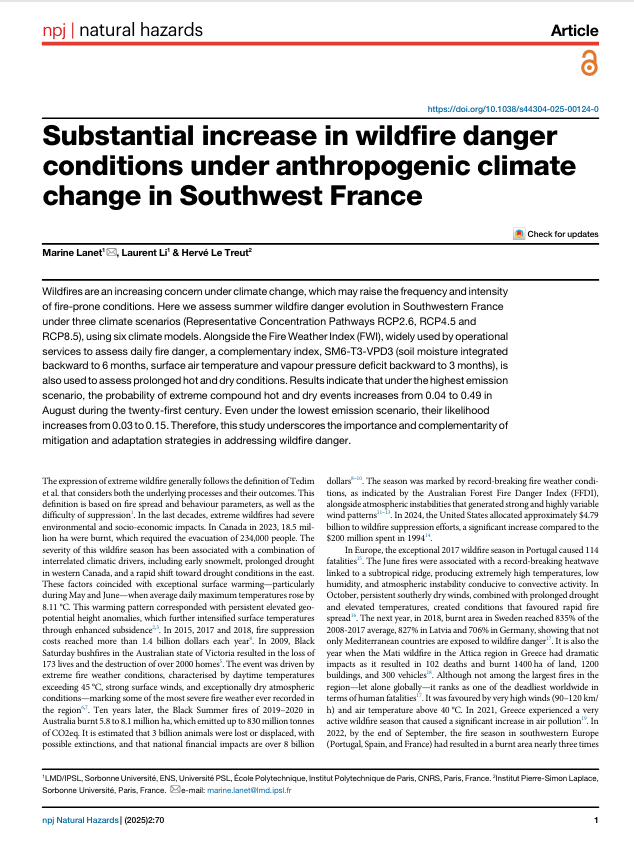
Substantial increase in wildfire danger conditions under anthropogenic climate change in Southwest France
Authors
Marine Lanet, Laurent Li & Hervé Le Treut
Published 23 July 2025, This article is part of a collection entitled – “Wildfire Hazards in a Warming World” published in npj Natural Hazards.
Wildfires are an increasing concern under climate change, which may raise the frequency and intensity of fire-prone conditions. Here we assess summer wildfire danger evolution in Southwestern France under three climate scenarios (Representative Concentration Pathways RCP2.6, RCP4.5 and RCP8.5), using six climate models. Alongside the Fire Weather Index (FWI), widely used by operational services to assess daily fire danger, a complementary index, SM6-T3-VPD3 (soil moisture integrated backward to 6 months, surface air temperature and vapour pressure deficit backward to 3 months), is also used to assess prolonged hot and dry conditions. Results indicate that under the highest emission scenario, the probability of extreme compound hot and dry events increases from 0.04 to 0.49 in August during the twenty-first century. Even under the lowest emission scenario, their likelihood increases from 0.03 to 0.15. Therefore, this study underscores the importance and complementarity of mitigation and adaptation strategies in addressing wildfire danger.

Authors
Marine Lanet, Laurent Li, Antoine Ehret, Solène Turquety & Hervé Le Treut
Published in partnership with CECCR at King Abdulaziz University I November 6th, 2024
Summer 2022 was exceptionally hot and dry in Europe and especially in Southwest France where the most important wildfires since 1949 had serious environmental and socio-economic impacts. An impact-oriented climate change attribution study was conducted and published recently by Marine Lanet (Laboratoire de météorologie dynamique, Sorbonne Université, CNRS) and her colleagues from IPSL (Institut Pierre Simon Laplace, Sorbonne Université, CNRS). The authors firstly investigated an ensemble of climate indices in order to find the most correlated one with the burnt area of the Landes Forest.
Measuring Infiltration Rates in Permeable Asphalt Pavement
in Urban Landscapes

Authors
Dansani Vasanthan Muttuvelu and Jes Vollertsen – Dept. of the Built Environment, Aalborg University, 9000 Aalborg, Denmark
Simon Wyke – Dept. of Sustainability and Planning, Aalborg University, 9000 Aalborg, Denmark
Published Online 23 July 2024
Efficient water management of roads has become increasingly important due to the escalating challenges posed by climate change. The existing body of research focusing on permeable pavements with surface layers of asphalts, concrete, and interlocking pavers, is limited, especially with respect to the use of porous asphalt as a surface layer is. Addressing the challenges and opportunities associated with permeable asphalt pavements, such as cleaning practices and maintaining infiltration efficiency is, nonetheless, essential to improve and advance urban engineering practices.